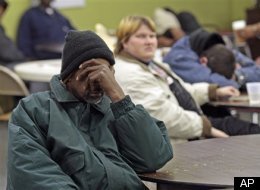
It's not a recession that consumers can end

"Even corporate leaders have to realize at some point that their companies will not remain profitable if the people no longer are able to buy anything. A rising tide may lift all boats, but the rising ocean swells from the bottom, not from the top."

- New York Times reader in a story about the plunge in public opinion of Congressional members following the recently concluded debt limit debate 

Top 299 CEOs' salaries could support 103,325 workers

This from Bloomberg.com, via The Week:

"Chief executive officers at 299 U.S. companies earned a combined total of $3.4 billion in 2010, a 23% increase from the year before. That amount would support 102,325 workers earning a median wage."


Nevada's and Las Vegas' Jobless Rates Fall - For the Wrong Reasons

Nevada’s unemployment rate dropped significantly in January, but not because of improving economic fortunes, but because discouraged workers have stopped looking for work or have left the state, the Nevada Department of Employment, Training and Rehabilitation announced earlier this morning.

“Unfortunately, the decrease was not driven by significant improvement in the labor market” said Bill Anderson, the DETR's chief economist. “It appears likely that some jobless Nevadans are becoming discouraged and giving up their search for work and dropping out of the labor force. In addition, given stagnant population levels, it is also likely that some Nevadans are leaving the state.”

Nevada’s jobless rate fell from a revised 14.9% in December to 14.2% in January.The unemployment rate in the Las Vegas area fell from 15.1% in December to 13.7% in January.

However, roughly 10,700 workers dropped out of the labor force in January, which was nearly the same decrease in the number of unemployed. Household employment remained virtually unchanged, the department reported.

The sobering announcement came after improving Nevada economic news in recent months. For instance, key indicators of the state’s economic well being, such as visitor statistics, gaming win and taxable sales, have exceeded expectations. A number of workforce indicators have stabilized, too, including the unemployment rate, although it's still inflated. “Not all is positive though,” Anderson said in the statement. “The recent surge in gas prices will undoubtedly affect travel to Nevada and continued pressure on government payrolls will likely offset any near term improvement in private sector hiring. It appears Nevada will continue to move sideways, bouncing along the trough of this recession for the foreseeable future.”

What Life is Really Like for Many Las Vegans Living Through the Great Recession

Although it's now a year old, this is one of the most powerful and accurate portrayals I've seen to-date about what life is like today for many Las Vegans living through the Great Recession.


Jobless rate falls, but Nevada still most unemployed state in October - for 6th consecutive month

While Nevada and other U.S. states' and regions' unemployment rates dropped in October, the Silver State still has the dubious ranking as number one in unemployment per capita in the country.

It was the sixth consecutive month the state led unemployment among in the United States. The states with the next highest jobless rates were Michigan, at 12.8%, and California, 12.4%, The New York Times reported.

And another national publication has recognized the difficulty of finding work in Sin City. Forbes.com has ranked Las Vegas the worst U.S. city for finding a job.

The hiring environment may be improving, but job seekers in cities that rely on strong economy-reliant industries should know that they may each be competing with six, seven or eight other idle workers for one advertised job, Forbes.com reported.

In arriving at its rankings, Forbes relied on figures from Juju.com, a site that aggregates job listings to arrive at its monthly Job Search Difficulty Index, which measures how tough it is to find employment in 50 major cities around the country.

"The cities that have continued to underperform rely on jobs from lagging industries such as manufacturing, tourism and construction," Juju vice president Brendan Cruickshank told Forbes.com. "Detroit and Las Vegas have improved from this time last year, but they continue have more unemployed individuals per open job than other large metropolitan areas."

Sunbelt cities like Las Vegas dominate the list of the most difficult metro areas for finding a job. Large metropolitan areas like Los Angeles, Miami and New Orleans continue to suffer as their tourism remains weak.

Although things are still tough in some areas, nationally things have improved, according to the report. "If you look back to November 2009, the average number of unemployed people per job posting was 6.5. This year it is 3.19," Cruickshank said. "This indicates that the market has gotten significantly better."

Nevada's Unemployment Rate Falls for First Time in Five Years

Nevada's jobless rate has fallen for the first time in five years, the state Department of Employment, Training and Rehabilitation reported this morning.

Joblessness decreased two-tenths of a point, to 14.2% in October over September, the DETR announced in a statement. The improvement was even more pronounced in Las Vegas, where unemployment fell from 15% in September to 14.1% last month.

"This is a clear sign that the recession's grip on Nevada may finally be loosening," DETR Chief Economist Bill Anderson said in the statement. "The number of jobs being eliminated is stabilizing, but there is no sign of major job growth on the horizon. While the decline in the rate is immediate good news, there is still a long road ahead to completely recover from the devastating effects of the recession."

The U.S. unemployment rate in October was 9.6%.  
 
The last time the jobless rate declined was in December 2005, when the local economy was booming and unemployment decreased to 4.2%. Since then, the Great Recession has devastated Nevada's tourism and construction industries, and the state has led the nation in joblessness, bankruptcies and foreclosures. In total, 181,600 Nevadans, and 135,000 Las Vegas Valley residents were without work in October.

Republican-controlled Congress more intent on tax cuts than jobless benefits extension

Jobless benefits will run out for 2 million Americans during the holiday season unless they are renewed by a Congress that's focusing more attention on a quarrel over preserving tax cuts for people making more than $200,000 a year.

It's looking iffy at best whether Congress will renew jobless benefits averaging $310 per week nationwide that are presently claimed by almost 5 million people who have been out of work for more than six months.

An extension of jobless benefits enacted this summer expires Dec. 1, and on Thursday, a bill to extend them for three months failed in the House. Democrats brought the bill to the floor, but Republicans opposed the legislation because they were denied a chance to attach spending cuts.

Still, the looming expiration of unemployment benefits could put Republicans on the defensive since they'll expire just as debate peaks in the lame-duck session over whether to extend Bush-era tax cuts on individuals with income exceeding $200,000 or for couples making more than $250,000. The tax cuts expire Dec. 31, and Democrats oppose permanently extending the upper-bracket tax cuts, which would cost about $700 billion over 10 years. "I don't think we want to leave here having fought for tax cuts for millionaires and against unemployment insurance for those that have lost their jobs," White House spokesman Robert Gibbs said.

Every recession since 1950 has featured an extended federal benefits program financed with deficit dollars. Allowing benefits to expire in the holiday season may draw negative attention to Republicans, especially when measured against their insistence on renewing tax cuts for upper-income taxpayers.

Today's Titans of Industry Should Follow Henry Ford's Lead

Drawing on the success Model T creator Henry Ford enjoyed when he doubled his factory workers' pay to $5 a day in 1914, a Harvard Business Review contributing editor is recommending that American companies do the same today.

Well, maybe not double workers' pay, but at least share with them some of the record-breaking profits companies have enjoyed as they downsized millions of American during the Great Recession.

"This is relevant now because we're dealing with a new crisis in consumer demand," John Landry writes in an HBR blog post titled "Time for a New Five-Dollar Day. "As many have pointed out, average pay in the United States has been stagnant or declining for decades." And now, "from households to governments, everyone has big debts to pay off, so it's going to be hard to emerge from the recession.

"Everyone, that is, except companies. The flip side of stagnant worker pay has been above-average corporate profits. All the talk about highly competitive markets has hidden the fact that most companies have done quite well in the past two decades."

Landry said the recent election of more Republicans will mean even less regulation and fewer taxes for businesses, another reason they should share their largesse. Because the problem isn't with businesses, "It's with consumers" who are hurting so badly financially that they can't buy many companies' products, Landry concludes.

 Related articles

Washington, D.C. Easiest Place to Get a Job, Las Vegas Most Difficult, Index Finds

The job-to-worker ratio is almost perfectly balanced in Washington, D.C., at 1.11:1, making it least difficult U.S. city in which to find a job, while in the nation's worst job market, Las Vegas, almost nine job seekers are vying for every open position.

That's acccording to the monthly Job Search Difficulty Index by job search engine JuJu.com, which measures the difficulty of finding employment in major cities around the country.

Las Vegas dropped below Miami in the November index, taking the 50th - or dead last - last spot previously held by Miami.

The Index was calculated by dividing the number of unemployed workers in each metro area, as reported by the Bureau of Labor Statistics (BLS), by the number of jobs in Juju's index of millions of online jobs in the United States, which is includes job postings from thousands of employer career portals, recruiter websites and job boards.

BusinessInsider.com has taken Juju.com's stats to create a slide show of the 10 Worst Cities for Finding a Job.

Economic stress eases in all but six states, including Nevada, AP finds

The nation's economic stress fell in September to a 16-month low, and 80% of the nation's 3,141 counties saw some relief from the Great Recession's economic pain, but six states - including my home state of Nevada saw conditions worsen, according to AP's monthly Economic Stress Index.

Nevada again was the most stressed, with a score of 21.93. California with 16.15., Florida with 15.86, Michigan with 15.76 and Arizona with 14.9 rounded out the top five.

Among counties, the Top 10 are dominated by those in Nevada, California, Florida and Arizona. Las Vegas' Clark County was 6th, with a stress index of 23.5.

The AP's index calculates a score for each county and state, from 1 to 100, based on unemployment, foreclosure and bankruptcy rates. A higher score indicates more economic stress. Under a rough rule of thumb, a county is considered stressed when its score exceeds 11.

The average county's Stress score in September was 10, down from 10.3 in August. The last time the average was that low was in May 2009. Just more than one-third of counties were deemed stressed in September, down from 40% in August.

North Dakota remained the economically healthiest state with a score of 3.75. Next came South Dakota (4.78), Nebraska (5.73) and Vermont (5.89). New Hampshire leapfrogged over Wyoming for the No. 5 spot with a score of 6.79.

A glaring exception to lower distress in much of the country was Nevada. It led the nation in September unemployment with a 14.4% rate and also was No. 1 in foreclosures; 6% of homes there were in some stage of the foreclosure process. In addition, Nevada was the leader in bankruptcy filings, too, with nearly 3% of the population in the bankruptcy process.

Still, some hints suggest the worst is nearing an end in Nevada. Gaming revenue has enjoyed a small upswing. And while Nevada's housing market shows no signs of picking up, prices are starting to stabilize, Stephen Brown, an economist at the University of Nevada, Las Vegas, told the AP.

Related articles